 I am a co-signer of this open letter calling for dialogue and an end to U.S. intervention in Venezuela. The full letter can be read here.
Showing posts with label Human Rights. Show all posts
Showing posts with label Human Rights. Show all posts
Thursday, January 24, 2019
Co-signed open letter on Venezuela in Common Dreams
I am a co-signer of this open letter calling for dialogue and an end to U.S. intervention in Venezuela. The full letter can be read here.Tuesday, December 18, 2018
La Saline massacre
Read here a short article that I have written for The Canary, a news website based in the UK. The article looks at the recent massacre conducted by state and/or state backed forces in the neighborhood of La Saline in Port-au-Prince, Haiti. See here for a French version.
US-backed Haitian government agents accused of conducting massacre— The Canary US (@TheCanaryUS) December 20, 2018
By @JebSpraguehttps://t.co/mCCl3jCvKA
Tuesday, October 2, 2012
OpEd in Miami Herald
 I have a new article published here in the Miami Herald. It is titled "Reviving Haiti’s army would harm democracy". Click here to read.
Wednesday, November 2, 2011
WBAI Interview

http://archive.wbai.org/files/mp3/wbai_110811_210038thurs9pm10pm.mp3
Thursday, October 6, 2011
U.S. Embassy Cables reveal 4,795 refugees fled Haiti in 2004: a 40% increase from the year prior
Cables from the U.S. Embassy in Nassau, Bahamas, obtained by the whistle blower WikiLeaks show that at least 4,795 Haitians fled their island nation in 2004.
Serving as corroborating evidence for the findings of the Kolbe-Hudson (Lancet study) in addition to other corroborating human rights reports (Amnesty International, University of Miami, Lawyers Guild, University of Boston, etc), increased refugee flows - 40% increase as stated
- is evidence of the major violence propelled by the paramilitaries.
See the entire Cable here:
Tuesday, August 16, 2011
Participation active des responsables américains et onusiens quant à l'intégration de puchistes à la PNH, selon WikiLeaks (Haïti).
Par Jeb Sprague
Haiti Liberté: Édition du 10 Août au 16 Août 2011 & CHAN.
 Tout au long de 2004 et 2005, les autorités non élues de facto d’Haïti,
aux côtés de fonctionnaires étrangers, ont intégré au moins 400
paramilitaires de l’ancienne Armée dans la force de police du pays,
selon ce que révèlent des câbles secrets de l’ambassade américaine.
Pendant un an et demi après le renversement du gouvernement élu
d’Haïti, le 29 février 2004, l’ONU, l’OEA et des responsables
américains, en conjonction avec les autorités haïtiennes de
l’après-coup, ont passé au crible la nouvelle force de la police du pays
- agent par agent - et ont intégré des paramilitaires dans le but de
renforcer à la fois le corps policier et en fournissant une «carrière»
alternative aux paramilitaires.
Sunday, August 14, 2011
WikiLeaks revela: Funcionarios de EE.UU. y la ONU supervisaron la incorporación de paramilitares a la policía de Haití
por Jeb Sprague
A lo largo de 2004 y 2005, las
autoridades de Haiti, en colaboración con funcionarios extranjeros, incorporaron
a por lo menos 400 paramilitares a la policía, según cables secretos de la embajada
de los EE.UU. .
Después del derrocamiento del Presidente Jean-Bertrand Aristide en
febrero de 2004, la ONU, la OEA y funcionarios de EE.UU., en colaboración con el
nuevo gobierno haitiano , aprobaron —uno por
uno— la incorporación de dichos paramilitares con el objetivo de
fortalecer a la policía y suministrar trabajo a los efectivos que
habían llevado a cabo el golpe de estado.
Al mismo tiempo, fueron purgados cientos de policías considerados leales
al gobierno del ex-presidente . Algunos fueron encarcelados y otros asesinados, segun
numerosas fuentes entrevistadas.
Aristide fue elegido por primera vez en 1991, pero el primer gobierno
democrático de Haití sólo duró siete meses antes de ser derrocado en un golpe
de estado militar. El ejército masacró a cerca de 3.000 personas y fueron
desplazados alrededor de 300.000 antes de que el gobierno de Clinton restituyó
a Aristide a la presidencia en 1994.
En
1995, Aristide abolió el ejército de Haití para prevenir más golpes y parar los
abusos que seguían cometiendo los militares. Pero cuando Aristide volvió a
ganar la presidencia en 2001 los élites haitianos reunieron a muchos de los
ex-soldados en grupos paramilitares para ejecutar otro golpe de estado.
Después
de este golpe, los paramilitares establecieron bases militares —oficial y extraoficialmente— en varias ciudades del país.
Desde estas bases se desató otra oleada de represión contra los simpatizantes
del partido de Aristide, Fanmi Lavalas. Los paramilitares mataran
aproximadamente 7.000 personas y cometieron otros abusos, como la violación
sexual a miles de mujeres y niñas. Son estos mismos individuos que fueron
incorporados a la policía nacional.
Los
detalles sobre la "reforma" a la policía se encuentran en
los 1.918 documentos (cables de la embajada de EE.UU.) relacionados a
Haití obtenidos por WikiLeaks y después entregados a Haití Liberté.
Wednesday, August 10, 2011
WikiLeaks Reveal: U.S. and UN Officials Oversaw Integration of Ex-Army Paramilitaries into Haiti’s Police Force
by Jeb Sprague
Throughout
2004 and 2005, Haiti’s unelected de facto
authorities, working alongside foreign officials, integrated at least 400
ex-army paramilitaries into the country’s police force, secret U.S. Embassy
cables reveal.
For
a year and a half following the ouster of Haiti’s elected government on Feb.
29, 2004, UN, OAS, and U.S. officials, in conjunction with post-coup Haitian
authorities, vetted the country’s police force – officer by officer –
integrating paramilitaries with the goal of both strengthening the force and
providing an alternative “career path”
for paramilitaries.
Wednesday, March 9, 2011
On Martissant, Gran Ravine, and Missing the Proportionality and Chief Sources of Political Violence
 |
| Above: Commemoration of the first anniversary of Gran Ravine's Massacre. The parents and friends of victims of the July 7, 2006 massacre walked with tears on the one year anniversary. Photo by Wadner Pierre |
Sunday, March 6, 2011
More on Gran Ravine and Martissant.. The 2005 HNP Report on Lame Ti Manchet and the Involvement of Officers Within HNP Ranks
I am posting here a report that was put together by Haiti's National Police (HNP) on the involvement of some of its officers with Lame Ti Manchèt (the Little Machete Army) during the time of the Latortue interim government in Haiti.
This report, put together by HNP officials, sheds some little light on one attack that was part of a much wider campaign of continual violent joint-paramilitary/police operations conducted throughout much of 2004 and part of 2005 (as a good deal of film evidence and testimonials by witnesses and victims attest). During this time period, following the 2004 coup, an unelected "interim" government worked with sectors of Haiti's elite and security force to crackdown on communities where support for ousted elected government remained strong in the slums of Port-au-Prince. This resulted in the killing, wounding, firing from jobs, imprisonment, and exile of thousands. Numerous studies provided detail on this campaign of violence but focused mainly on what happened in Bel Air and Cité Soleil (Lawyers Guild, Harvard study, University of Miami Study, Lancet, etc).
Sunday, January 23, 2011
End Forced Exile
See here for a petition that was published today in the Miami Herald calling for the Haitian government, the United States, France, Canada, and the United Nations to stop blocking the return of Haiti's first democratically elected president.
Thursday, December 30, 2010
Stealth Duvalierism
Haiti, Michel Martelly, and the Presidential Selection of 2010
Znet and Haiti Liberte
December 20, 2010
By Jeb Sprague
In the media coverage of Haiti's ongoing electoral crisis, presidential candidate Michel "Sweet Micky" Martelly, whom ruling Unity party candidate Jude Célestin edged out of Haiti's Jan. 16 run-off by less than 1%, has been portrayed as the victim of voting fraud and the leader of a populist upsurge against Haiti’s crooked Provisional Electoral Council (CEP).
Some have questioned his presidential suitability by pointing to his vulgar antics as a konpa musician over the last two decades, where he often made demeaning comments about women and periodically dropped his trousers to bare his backside.
The real problem with Martelly, however, is not his perceived immorality, but his heinous political history and close affi liation with the reactionary “forces of darkness," as they are called in Haiti, which have snuffed out each genuine attempt Haitians have made over the past 20 years to elect a democratic government. Far from a champion of democracy, Martelly has been a cheerleader for, and perhaps even a participant in, bloody coups d'état and military rule.
Thursday, November 1, 2007
Singing For The Poor: The Arcade Fire and Partners In Health in Haiti
I have a new piece up on the Inter Press Service. Some photos should be up soon on HaitiAnalysis.

Wednesday, October 10, 2007
We Miss You Lovinsky!
Haitian Human Rights leader Pierre-Antoine Lovinsky has gone missing now for nearly two months and is believed kidnapped. All of my thoughts right now are with his wife and children. We all miss you Lovinsky! Here is a photo I snapped of him with demonstrators in front of the Brazilian Embassy in Washington, D.C. back in July 2005.

Wednesday, September 5, 2007
AUMOHD Human Rights Reports
AUMOHD has posted a new report looking at ex-military led violence in the Central Plateau: Mirebalais-Lascaobas-Belladère.
As readers may know, AUMOHD has also (along with the Grand Ravine Community Human Rights Council - CHRC-GR) been highly active in one of the most impoverished areas in Port-au-Prince, Gran Ravine and Martissant. Their reports have constantly pointed to the driving force of violence being a group known as Lame Ti Manchet. Even some other groups less active in the area have begun acknowledging Lame Ti Manchets involvement. Not to worry though, Michael Deibert still believes hisblame-it-all-on-Aristide carefully crafted article is the true and "definitive" source on violence in these communities. He actually wrote recently that to the best of his knowledge his article is "the only authoritative English-language reporting on the conflict there." He must have never taken the time to read the translated reports of actual Haitian human rights workers that are in the communities daily. Earlier this year an organizer of HURAH gave him an ear full.
As readers may know, AUMOHD has also (along with the Grand Ravine Community Human Rights Council - CHRC-GR) been highly active in one of the most impoverished areas in Port-au-Prince, Gran Ravine and Martissant. Their reports have constantly pointed to the driving force of violence being a group known as Lame Ti Manchet. Even some other groups less active in the area have begun acknowledging Lame Ti Manchets involvement. Not to worry though, Michael Deibert still believes his
Saturday, August 18, 2007
MINUSTAH Hospitality
Wednesday/15 August 2007.
It is always amazing to see how hospitable and warm the Haitian people are, no matter where I go I am reminded of this. The people whose concrete apartment I am staying at now are so poor but they go out of their way continuously to make me feel at home. And I do. But today I received just the opposite impression from a Brazilian squad of MINUSTAH, the UN force garrisoned here in Haiti since 2004.
At about 12 in the afternoon I went down with a friend from Delmas street to the National Palace, in downtown Port-au-Prince, to cover a demonstration called for by the Fondasyon 30 Septamn (the September 30th Foundation). The group was founded by
Lovinsky Pierre Antoinne, a leading human rights and Fanmi Lavalas activist, who has gone missing and believed to be kidnapped. Lovinsky is a vocal advocate for the victims of both the 1991 and 2004 coups, both of which ousted Haiti's twice democratically elected
President Jean-Bertrand Aristide. A couple hundred members of the group were present. Many were lying on the ground and were visibly sad, others were standing crying out for the return of the deeply loved founder of their human rights organization.
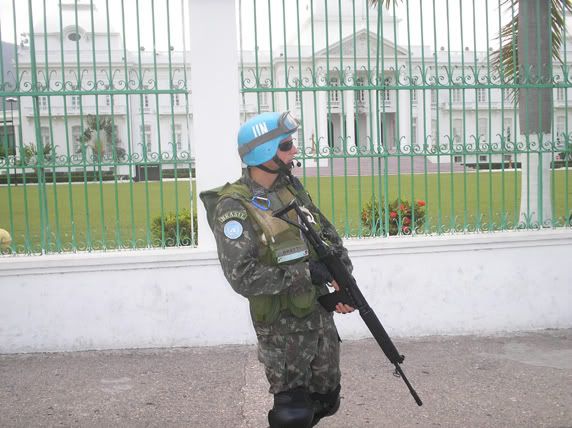
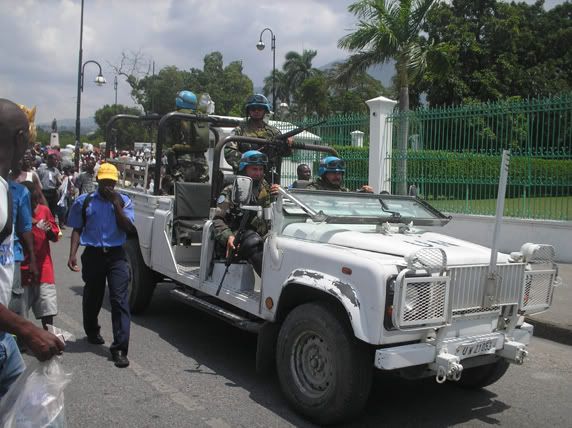
When we arrived at the National Palace we saw a dozen blue helmeted MINUSTAH soldiers standing in front, nearly all with machine guns drawn, along with two parked jeeps and one large tall APC with a mounted machine gun. Another large jeep showed up carrying four MINUSTAH soldiers, three wielding large machine guns.
I first snapped photos of the demonstration, then proceeded to snap photos of the heavily armed MINUSTAH contingent.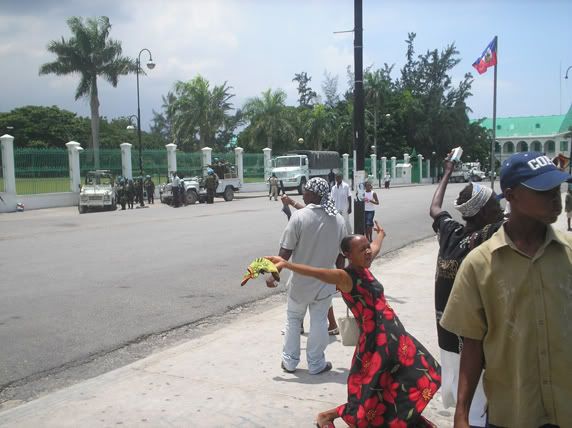
After standing nearby the troops for a few seconds fiddling with my camera, I saw one motion to the others and I was immediately surrounded by three of the Brazilian blue helmets. In threatening tones and postures they demanded to know what I was doing in Port-au-Prince. I explained that I was a university student and that I was working as a journalist for the Inter Press Service (IPS) trying to cover the demonstration. One of the MINUSTAH troops then yanked down on the large press badge around my neck, inspecting it thoroughly. It was a press badge for IPS. Twice more I told them I was a member of the press.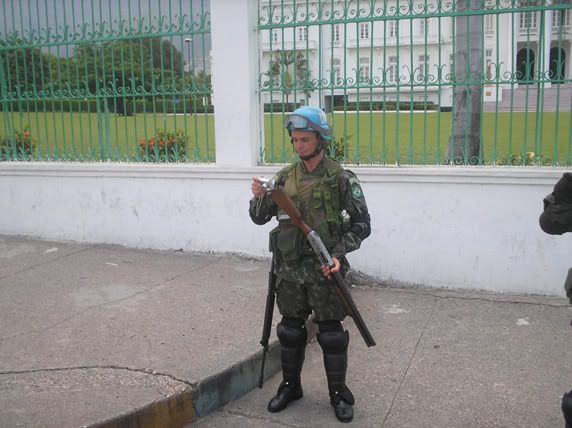
They then called over a fourth soldier with a camera. I protested. Next one of the soldiers, also holding a machine gun, swatted off my cap onto the ground. I repeated that this was a violation of my human rights. Two others put their arms on my shoulders and held me still near one of their vehicles. The 4th soldier meanwhile placed the camera close to my face and snapped a close up photo. They placed my press badge so my name would show clearly in the photo. The whole incident must have happened within a matter of fifteen seconds but it obviously felt intimidating.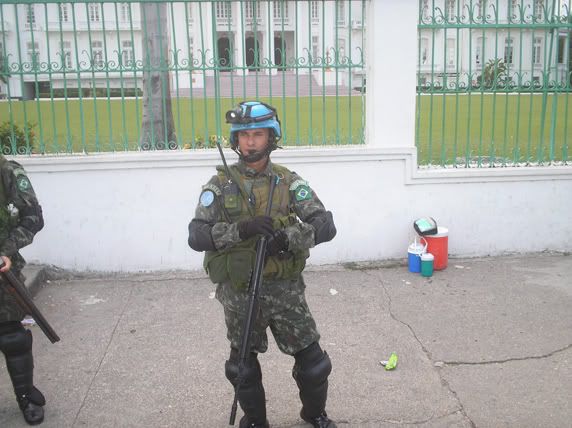
The captain of the Brazilian MINUSTAH squad who directed the others to grab me had a walkie talkie in his vest, along with a headset and some sort of camera or night vision device mounted on his helmet. Evel Fanfan (a committed and well known human rights organizer of AUMOHD who has been threatened on numerous occasions) was nearby. He observed that this was a common practice for the UN troops. MINUSTAH regularly harasses Haitian journalists and poor people, forcing them to allow a MINUSTAH soldier with a camera to take a close-up photo of their face, a form of data collection for UNOPS intelligence, he explained. Two young Haitian journalists from Cité Soleil told me that MINUSTAH tightly censors those journalists they allow into UN gatherings in Port-au-Prince.
Poor Haitian journalists never paint the amiable picture of MINUSTAH that we hear so often from embedded journalists writing for many of the major US or European media outlets, who more common than one would expect wear-two-hats, working simultaneously for US government funded outlets like the Voice of America (VOA). One can easily be reminded by looking back at the
photographs and documentation of human rights reports of what impoverished Haitians have had to endure since Feb 2004.
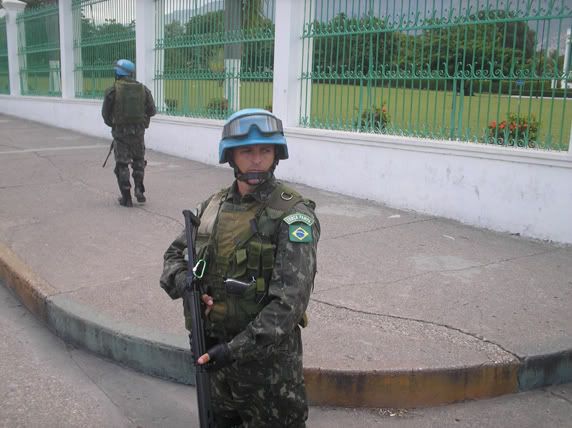
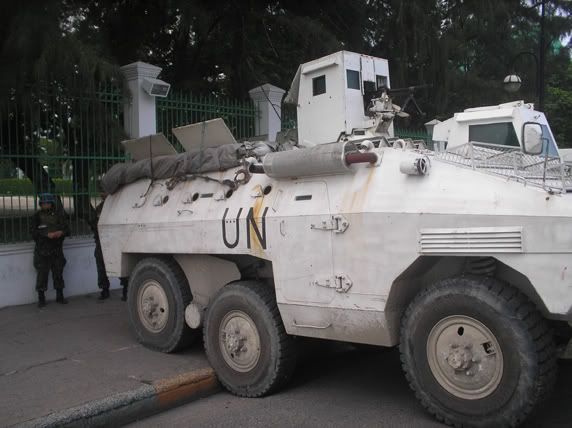
The Brazilian army has a long and shady history. Early on it was used as a violent apparatus for repressing slave revolts. During the 20th century the army utilized
terror campaigns to stamp out leftist and landless peasant movements.
19 September 2007 Update: Over one month later and Lovinsky Pierre Antoine is still missing. Back in December 2006 Lovinsky appeared on Pacifica Radio's Democracy Now.
It is always amazing to see how hospitable and warm the Haitian people are, no matter where I go I am reminded of this. The people whose concrete apartment I am staying at now are so poor but they go out of their way continuously to make me feel at home. And I do. But today I received just the opposite impression from a Brazilian squad of MINUSTAH, the UN force garrisoned here in Haiti since 2004.
At about 12 in the afternoon I went down with a friend from Delmas street to the National Palace, in downtown Port-au-Prince, to cover a demonstration called for by the Fondasyon 30 Septamn (the September 30th Foundation). The group was founded by
Lovinsky Pierre Antoinne, a leading human rights and Fanmi Lavalas activist, who has gone missing and believed to be kidnapped. Lovinsky is a vocal advocate for the victims of both the 1991 and 2004 coups, both of which ousted Haiti's twice democratically elected
President Jean-Bertrand Aristide. A couple hundred members of the group were present. Many were lying on the ground and were visibly sad, others were standing crying out for the return of the deeply loved founder of their human rights organization.
When we arrived at the National Palace we saw a dozen blue helmeted MINUSTAH soldiers standing in front, nearly all with machine guns drawn, along with two parked jeeps and one large tall APC with a mounted machine gun. Another large jeep showed up carrying four MINUSTAH soldiers, three wielding large machine guns.
I first snapped photos of the demonstration, then proceeded to snap photos of the heavily armed MINUSTAH contingent.
After standing nearby the troops for a few seconds fiddling with my camera, I saw one motion to the others and I was immediately surrounded by three of the Brazilian blue helmets. In threatening tones and postures they demanded to know what I was doing in Port-au-Prince. I explained that I was a university student and that I was working as a journalist for the Inter Press Service (IPS) trying to cover the demonstration. One of the MINUSTAH troops then yanked down on the large press badge around my neck, inspecting it thoroughly. It was a press badge for IPS. Twice more I told them I was a member of the press.
They then called over a fourth soldier with a camera. I protested. Next one of the soldiers, also holding a machine gun, swatted off my cap onto the ground. I repeated that this was a violation of my human rights. Two others put their arms on my shoulders and held me still near one of their vehicles. The 4th soldier meanwhile placed the camera close to my face and snapped a close up photo. They placed my press badge so my name would show clearly in the photo. The whole incident must have happened within a matter of fifteen seconds but it obviously felt intimidating.
The captain of the Brazilian MINUSTAH squad who directed the others to grab me had a walkie talkie in his vest, along with a headset and some sort of camera or night vision device mounted on his helmet. Evel Fanfan (a committed and well known human rights organizer of AUMOHD who has been threatened on numerous occasions) was nearby. He observed that this was a common practice for the UN troops. MINUSTAH regularly harasses Haitian journalists and poor people, forcing them to allow a MINUSTAH soldier with a camera to take a close-up photo of their face, a form of data collection for UNOPS intelligence, he explained. Two young Haitian journalists from Cité Soleil told me that MINUSTAH tightly censors those journalists they allow into UN gatherings in Port-au-Prince.
Poor Haitian journalists never paint the amiable picture of MINUSTAH that we hear so often from embedded journalists writing for many of the major US or European media outlets, who more common than one would expect wear-two-hats, working simultaneously for US government funded outlets like the Voice of America (VOA). One can easily be reminded by looking back at the
photographs and documentation of human rights reports of what impoverished Haitians have had to endure since Feb 2004.
The Brazilian army has a long and shady history. Early on it was used as a violent apparatus for repressing slave revolts. During the 20th century the army utilized
terror campaigns to stamp out leftist and landless peasant movements.
19 September 2007 Update: Over one month later and Lovinsky Pierre Antoine is still missing. Back in December 2006 Lovinsky appeared on Pacifica Radio's Democracy Now.
Monday, August 13, 2007
Where is Lovinsky?
The radio here in Port-au-Prince is reporting that Lovinsky Pierre-Antoine, a long time human rights activist and lavalas organizer, has disapeared. His car was found this morning and a police report has been filed.

Monday, February 26, 2007
Unmarked graves where flowers grow
This wonderful band The Arcade Fire (from Canada) spoke out against the 2004 coup and right now they are raising money for Partners in Health (PIH). Arcade Fire’s lead singer Régine Chassagne was born in Haiti, but her family emigrated to Canada to escape the terror of the Duvalier regime. Here they are performing their hit-song "Haiti":
Haïti, mon pays,
wounded mother I'll never see.
Ma famille set me free.
Throw my ashes into the sea.
Mes cousins jamais nés
hantent les nuits de Duvalier.
Rien n'arrete nos esprits.
Guns can't kill what soldiers can't see.
In the forest we are hiding,
unmarked graves where flowers grow.
Hear the soldiers angry yelling,
in the river we will go.
Tous les morts-nés forment une armée,
soon we will reclaim the earth.
All the tears and all the bodies
bring about our second birth.
Haïti, never free,
n'aie pas peur de sonner l'alarme.
Tes enfants sont partis,
In those days their blood was still warm
See this http://www.youtube.com/v/RuBLzbzwsYc
Wednesday, February 14, 2007
Manipulating Death in Martissant and Gran Ravine
A freelance photojournalist Jean Rémy Badiau was killed on January 19 2007 in the Port-au-Prince district of Martissant. AHP interviewed family and friends that claimed his murder was connected to the vigilante group Lame Ti Manchet. The Haitian newspaper Nouvelliste made a similar report on February 13.
In an earlier report the Paris-based Reporters Sans Frontières placed equal blame for violence in Martissant on another group known as Baz Gran Ravine. The report provided no proof to back up the statement. A recent article for AlterPresse by Michael Deibert states that Badio was "murdered in his home, evidently by gang-affiliated gunmen from the area, last month". The article made no mention of the widespread charges against Lame Ti Manchet for having involvement in the killing of Badio and scores of other people in Martissant.
A previous article (August 2 2006) by Deibert on the violence in Martissant also ignored the numerous documented attacks and killings carried out by the group, acknowledging only the charges that "a former police official" was accused of "financing and organizing a gang known as Lamè Ti Machet". He makes no mention of the numerous and well recorded Lame Ti Manchet attacks.
>
According to human rights workers active consistently in Martissant, such as those within AUMOHD and the Community Human Rights Councils (CHRC), it is the Lame Ti Manchet that has been responsible for the vast amount of reported attacks over the last few years and is the driving force behind violence in the area. Also the Komisyon Episkopal Nasyonal Jistis ak Lapè has gathered statistics over the last few years that also show the Lame Ti Manchet was the main perpetrator of violence in the area. This does not mean that Baz Gran Ravine and armed groups committed no violence, but it does mean that according to human rights workers and community groups in Martissant the vigilante group known as Lame Ti Manchet conducted the huge majority of recorded violence and was really a driving force for killings in the area. Disturbingly Lame Ti Manchest was also documented to have had connections with the police force during the interim government.
AUMOHD observed that the 2006 massacre conducted by Lame Ti Manchèt "was meant as a smoke screen to provoke Baz Gran Ravine into a retaliation and thereby distract from the push to get police and civilians involved with Lame Ti Manchèt into jail. AUMOHD'S community human rights council (CHRC) coordinator, Esterne Bruner, was assassinated by Lame Ti Manchèt 9/21/06. But there has not been any retaliation reported. Instead the CHRC, non-violent and non-partisan, continues to prosecute all the killings".
Other attacks conducted by Lame Ti Manchet which is also ignored by Deibert include a massacre of 21 people, the burning down of 300 homes 7/9/06, and a massacre carried out jointly with the Haitian police at a USAID sponsored soccer tournament 8/20/05. The attempts at transference and manipulation are important to document because they show how scientific human rights studies (Lancet, Miami University Griffin report, etc) and testimony collected by human rights workers (AUMOHD, CHRC, IJDH) from poor victims of violence is ignored. Many of the same authors/groups that ignore the reports coming from Martissant also ignored the half dozen human rights reports that came out during the 04-06 period showing the interim government's role in violence against slum dwellers, such as the extrajudicial killing of young journalist Abdias Jean.
Human rights workers on the ground in Martissant now report that the wife of Rudy Kernizan has been apprehended. Rudy himself - chief of the vigilante Lame Ti Manchet - has escaped reportedly to the Dominican Republic. In early February human rights workers reported that several (3-4) Lame Ti Manchet people were arrested by MINUSTAH and the Haitian police. Another 31 individuals were arrested days ago in Martissant.

Funeral of Jean Rémy Badiau
(Photo: Guyvard Alexis/APH)

Young victim of Lame Ti Manchet (Photo: AUMOHD)
In an earlier report the Paris-based Reporters Sans Frontières placed equal blame for violence in Martissant on another group known as Baz Gran Ravine. The report provided no proof to back up the statement. A recent article for AlterPresse by Michael Deibert states that Badio was "murdered in his home, evidently by gang-affiliated gunmen from the area, last month". The article made no mention of the widespread charges against Lame Ti Manchet for having involvement in the killing of Badio and scores of other people in Martissant.
A previous article (August 2 2006) by Deibert on the violence in Martissant also ignored the numerous documented attacks and killings carried out by the group, acknowledging only the charges that "a former police official" was accused of "financing and organizing a gang known as Lamè Ti Machet". He makes no mention of the numerous and well recorded Lame Ti Manchet attacks.
>
According to human rights workers active consistently in Martissant, such as those within AUMOHD and the Community Human Rights Councils (CHRC), it is the Lame Ti Manchet that has been responsible for the vast amount of reported attacks over the last few years and is the driving force behind violence in the area. Also the Komisyon Episkopal Nasyonal Jistis ak Lapè has gathered statistics over the last few years that also show the Lame Ti Manchet was the main perpetrator of violence in the area. This does not mean that Baz Gran Ravine and armed groups committed no violence, but it does mean that according to human rights workers and community groups in Martissant the vigilante group known as Lame Ti Manchet conducted the huge majority of recorded violence and was really a driving force for killings in the area. Disturbingly Lame Ti Manchest was also documented to have had connections with the police force during the interim government.
AUMOHD observed that the 2006 massacre conducted by Lame Ti Manchèt "was meant as a smoke screen to provoke Baz Gran Ravine into a retaliation and thereby distract from the push to get police and civilians involved with Lame Ti Manchèt into jail. AUMOHD'S community human rights council (CHRC) coordinator, Esterne Bruner, was assassinated by Lame Ti Manchèt 9/21/06. But there has not been any retaliation reported. Instead the CHRC, non-violent and non-partisan, continues to prosecute all the killings".
Other attacks conducted by Lame Ti Manchet which is also ignored by Deibert include a massacre of 21 people, the burning down of 300 homes 7/9/06, and a massacre carried out jointly with the Haitian police at a USAID sponsored soccer tournament 8/20/05. The attempts at transference and manipulation are important to document because they show how scientific human rights studies (Lancet, Miami University Griffin report, etc) and testimony collected by human rights workers (AUMOHD, CHRC, IJDH) from poor victims of violence is ignored. Many of the same authors/groups that ignore the reports coming from Martissant also ignored the half dozen human rights reports that came out during the 04-06 period showing the interim government's role in violence against slum dwellers, such as the extrajudicial killing of young journalist Abdias Jean.
Human rights workers on the ground in Martissant now report that the wife of Rudy Kernizan has been apprehended. Rudy himself - chief of the vigilante Lame Ti Manchet - has escaped reportedly to the Dominican Republic. In early February human rights workers reported that several (3-4) Lame Ti Manchet people were arrested by MINUSTAH and the Haitian police. Another 31 individuals were arrested days ago in Martissant.
Funeral of Jean Rémy Badiau
(Photo: Guyvard Alexis/APH)
Young victim of Lame Ti Manchet (Photo: AUMOHD)
Tuesday, January 30, 2007
Letter to Amnesty International
I recently sent this email to Amnesty International.
Dear Amnesty International,
I am concerned that your recent public statement on Jean-Rémy Badio missed some important issues.
Your post came soon after a statement by RSF and you stated "On 19 January, he was reportedly shot at his home in Martissant where gang warfare has been spiraling for more than two years."
This statement appears to agree with RSF’s Canadian Director Générale's recent statement that “Two armed gangs – Lame Ti Manchèt (Little Machete Army) and Baz Gran Ravin (Big Ravine Base) – have been fighting for the control of Martissant for the past two years.”
This assessment is far from the truth according to those living on the ground and human rights workers who are active daily in Martissant. I point you to an article I recently published at http://www.narconews.com/Issue44/article2517.html
Both family and friends of the victim, Jean-Rémy Badio, accuse lame Ti Manchèt of having a role in the killing. While RSF included Big Ravine Base in its press statement there has been no reports of any alleged involvement on their part. Press reports also indicate that it is the Lame Ti Manchèt and segments of the PNH that have done nearly all of the violence in Martissant.
Furthermore a human rights group that has focused its attention on Martissant, AUMOHD, states that the 2006 massacre conducted by Lame Ti Manchèt “was meant as a smoke screen to provoke Baz Gran Ravine into a retaliation and thereby distract from the push to get police and civilians involved with Lame Ti Manchèt into jail. AUMOHD’S community human rights council (CHRC) coordinator, Esterne Bruner, was assassinated by Lame Ti Manchèt 9/21/06."
AUMOHD reports that there has not been any reported retaliation on the part of the Baz Gran Ravine but that "Instead the CHRC, non-violent and non-partisan, continues to prosecute all the killings.”
I am concerned that your organization is being led away from the facts to appear to take a "neutral" position that is in fact a partisan position promoted by RSF that for them is politically expedient and exploitative. RSF helped propel a destabilization campaign against Haiti's elected government for example when its secretary general in 2002 called on the U.S. Congress and the EU to take "individual sanctions" against Aristide and Prime Minister Yvon Neptune, including "the refusal of entry and transit visas" and "the freezing of any foreign bank accounts they have". Following the illegal ouster of Haiti’s elected government RSF went silent on numerous abuses against the press and failed to denounce various assaults on journalists including the murder of grassroots journalist Abdias Jean.
I congratulate you on mentioning Abdias Jean in your recent report. I hope you will investigate the facts on the ground in Martissant. The voices of the family and friends of Badio should be heard.
Subscribe to:
Posts (Atom)