Showing posts with label transnational processes. Show all posts
Showing posts with label transnational processes. Show all posts
Friday, August 25, 2017

Wednesday, April 20, 2016
New article published in the peer reviewed journal Caribbean Studies

Tuesday, July 30, 2013
The Savage Wars of the Capitalist Peace: The New Geoeconomics & the Rise of China
Adelaide University's Dr. Kanishka Jayasuriya gives a keynote talk "The Savage Wars of the Capitalist Peace: The New Geoeconomics & the Rise of China". In the context of political science literature on "rising powers", he examines the weaknesses of nation-state centrism and mainstream thinking on the "rise of china", and how this ignores the more nuanced shifting socio-economic relations occurring through global capitalism and how this relates to China. To discuss this he looks in particular at the 'Asian Century White Paper Report' commissioned by the Australian government of former Prime Minister Julia Gillard. I recorded this talk in June of 2013 at the "Global Capitalism in Asia and Oceania conference" at Griffith University in Brisbane. This was the 2nd conference of the Network for Critical Studies of Global Capitalism (NCSGC). For more information see:http://netglobalcapitalism.wordpress.com
Tuesday, March 20, 2012
'Transnational State' entry in the Wiley-Blackwell Encyclopedia of Globalization
I have published a new piece in The Wiley-Blackwell Encyclopedia of Globalization that looks at the analytical abstraction of an emergent transnational state and its apparatuses. The full article can be read here. Here is the abstract:
 The theory of an emergent transnational state (TNS), as coined by sociologist William I. Robinson (2001), claims that through globalization a nascent political, juridical and regulatory network is coming into existence worldwide. This notion rests upon the idea that a dominant social force, a transnational capitalist class (TCC), propels globalization through transnational corporations (TNCs) (Robinson & Harris 2000). The TCC, to promote and ensure its power, requires a concomitant political project. Such a political project would involve, for example: (i) promoting investor confidence in the global economy, (ii) setting up mechanisms and institutions for responding to economic, political, and military crises that threaten the stability necessary for global markets, and (iii) establishing a degree of macroeconomic policy uniformity across borders.
Wednesday, July 13, 2011
A Review of Sociologist Robyn Magalit Rodriguez's NEW BOOK Migrants For Export
Migrants for Export: How the Philippine State Brokers Labor to the World, by Robyn Magalit Rodriguez. Minneapolis, Minnesota/London: University of Minnesota Press, 2010. $67.00; paper, $19.00. Pp. 208.
From government-sponsored nursing classes in Manila to crushed labor strikes at garment factories in southeast Asia, a variety of mechanisms have been developed to manage, promote and coerce Filipino workers as a readily available cheap source of labor around the world. A book of interest for scholars or students of global migration or of the contemporary Filipino/ Filipina experience, Migrants for Export should also be of interest to those studying the state in globalization and in relation to the changing practices and ideologies of state elites.
 Rodriguez starts by considering some theoretical issues behind the state and its interaction with migrants, and the historical roots of the novel processes of today’s global market and political economy. She explains how the modern Philippine state developed, first tightly bound to the United States as a colony and later as a component within a global system (yet, still closely aligned with the United States). It is in today’s era of global capitalism that Rodriguez seeks to understand, by way of the Philippines, the exploitive and contradictory nature of the state’s role in migration.
The book’s central argument is that the Philippine state has become actively involved in marketing its citizens to companies and labor-receiving governments around the world for low-wage and closely watched temporary jobs. The practices and ideologies of state elites have become rooted in this process — becoming active migration promoters and managers, such that the “orientation of Philippine officials and government agencies toward overseas employment reveals the extent to which Philippine citizens have become reduced to mere commodities to be bartered and traded globally”(27).
Tuesday, June 7, 2011
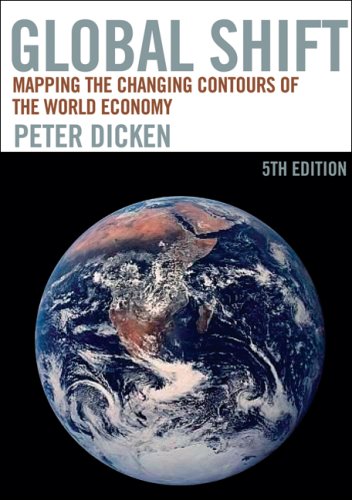
A Review of Peter Dicken's Global Shift: Mapping the Changing Contours of the World Economy, 5th Edition
Jeb Sprague
Widely cited and read by scholars and students of
globalization, Peter Dicken’s Global Shift is best known for its concise examination
of structures of the global economy. Now in its 5th edition with over 250 newly
designed figures and graphs, few texts are as effective in showing the
incontrovertible changes undergone in production, distribution and consumption.
Written prior to the crisis of recent years, it remains a useful guide for
understanding the truly global nature of today’s world economy. However, where
Dicken does a remarkable job in dissecting the structure of the global economy,
he has little or nothing to say about how the state and economic structure are
grounded in broader class and social relations.
Dicken starts, in Parts 1 and 2, by laying out
distinct ways in which scholars conceptualize globalization and the importance
of technological and networked development, as well as the role of
transnational corporations (TNCs) and national states. Part 3 describes
shifting economic sectors in the real economy: agriculture, autos, computers,
textiles and logistical infrastructure. Included within Part 3 is a chapter on
finance, but this is just 29 pages in a 599-page book. This chapter covers the
spread of financial services but has little discussion of derivatives (p. 386)
and nothing on the role of central banks or stock markets. Most importantly
though, for the purposes of this review, how does Global Shift treat the role
of social agency?
Tuesday, August 31, 2010
Statecraft in the Global Financial Crisis: An Interview with Kanishka Jayasuriya
By: Jeb Sprague
Journal of Critical Globalisation Studies
Kanishka Jayasuriya, Professor of Political Science at the University of Adelaide, Australia and author of two monographs – Reconstituting the Global Liberal Order: Legitimacy and Regulation (2005) and Statecraft, Welfare and the Politics of Inclusion (2006) – argues that changing forms of governance and new regulative laws are enabling the transnationalization of institutions within national states. He also interprets these changes as giving rise to a new type of institutional struggle unique to globalisation. For social scientists in general and political economists in particular, Jayasuriya’s work provides a useful lens through which to understand intra-state transformation in the global epoch. By rejecting Realist/Weberian conceptions of the state and drawing inspiration instead from materialist state theory, he understands state transformation as a reflection of ongoing processes linked to socio-economic forces that are novel to the historical present. And in the wake of the global financial crisis, he argues, we should not see the state as either disappearing or returning, for it is continuing to transform in ways peculiar to the age of globalism. The real question is for whom states will act in the future. In order to answer this, Jayasuriya suggests that we must look to transformations occurring within the national state, for it is these that are changing statecraft as we know it.
In this interview, Jayasuriya discusses some of his main concepts and theories, such as the regulatory state; meta-governance; the transition from ‘social constitutionalism’ to ‘economic constitutionalism’; and describes how each of these relate to the ongoing crisis of global capitalism. He clarifies his views on the idea of a transnational capitalist class, arguing that there must be “different fractions within it”; and goes on to discuss the connection of his theories on state-transformation with the related works of William Robinson and Martin Shaw. Finally, he discusses some of the theorists that have influenced his work – such as Nicos Poulantzas, Carl Schmitt, Franz Neumann, and Amartya Sen – and briefly describes his areas of ongoing research.
Journal of Critical Globalisation Studies
 |
| Kanishka Jayasuriya |
Kanishka Jayasuriya, Professor of Political Science at the University of Adelaide, Australia and author of two monographs – Reconstituting the Global Liberal Order: Legitimacy and Regulation (2005) and Statecraft, Welfare and the Politics of Inclusion (2006) – argues that changing forms of governance and new regulative laws are enabling the transnationalization of institutions within national states. He also interprets these changes as giving rise to a new type of institutional struggle unique to globalisation. For social scientists in general and political economists in particular, Jayasuriya’s work provides a useful lens through which to understand intra-state transformation in the global epoch. By rejecting Realist/Weberian conceptions of the state and drawing inspiration instead from materialist state theory, he understands state transformation as a reflection of ongoing processes linked to socio-economic forces that are novel to the historical present. And in the wake of the global financial crisis, he argues, we should not see the state as either disappearing or returning, for it is continuing to transform in ways peculiar to the age of globalism. The real question is for whom states will act in the future. In order to answer this, Jayasuriya suggests that we must look to transformations occurring within the national state, for it is these that are changing statecraft as we know it.
In this interview, Jayasuriya discusses some of his main concepts and theories, such as the regulatory state; meta-governance; the transition from ‘social constitutionalism’ to ‘economic constitutionalism’; and describes how each of these relate to the ongoing crisis of global capitalism. He clarifies his views on the idea of a transnational capitalist class, arguing that there must be “different fractions within it”; and goes on to discuss the connection of his theories on state-transformation with the related works of William Robinson and Martin Shaw. Finally, he discusses some of the theorists that have influenced his work – such as Nicos Poulantzas, Carl Schmitt, Franz Neumann, and Amartya Sen – and briefly describes his areas of ongoing research.
Monday, August 2, 2010
全球化的双重危机:从墨西哥湾到亚利桑那
杰布 斯普拉格(Jeb Sprague)& 西赛尔 罗德里格斯(Cesar Rodriguez) 。
从漂浮着絮状原油的墨西哥湾,到发生针对移民袭击事件的亚利桑那,如今我们的国家似乎正处于一种持续的紧张状态。而对于在全球化进程中居于核心地位的我们来说,这两则事件都能在我们社会的基本结构中找到其更为深刻的原因。
四月二十日,距离路易斯安那海岸五十英里远的英国石油公司(BP)海上钻井平台发生了爆炸事故,从而导致十一名工人丧生并引发大量原油从海底喷涌而出,这次原油泄漏事件是美国历史上最为严重的一次。而仅仅在三天后,亚利桑那州州长简•布鲁尔就签署了针对非法移民的第1070号新决议法案,要求州警核查一切有非法移民嫌疑的移民的法律地位。尽管这两件事看似毫无关联,但是在一个认为资本的积累远比人的生计和生存环境更为重要的价值体系内,考虑这两者如何复杂的进行相互作用就显得极为重要。
Subscribe to:
Posts (Atom)