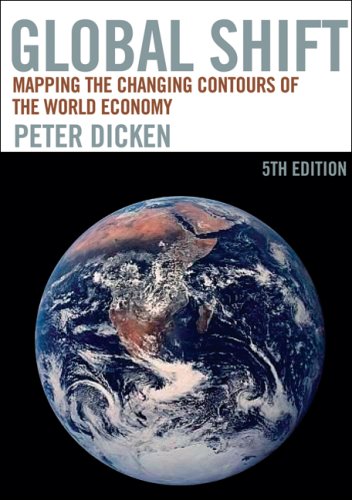
Jeb Sprague
Widely cited and read by scholars and students of
globalization, Peter Dicken’s Global Shift is best known for its concise examination
of structures of the global economy. Now in its 5th edition with over 250 newly
designed figures and graphs, few texts are as effective in showing the
incontrovertible changes undergone in production, distribution and consumption.
Written prior to the crisis of recent years, it remains a useful guide for
understanding the truly global nature of today’s world economy. However, where
Dicken does a remarkable job in dissecting the structure of the global economy,
he has little or nothing to say about how the state and economic structure are
grounded in broader class and social relations.

Dicken starts, in Parts 1 and 2, by laying out
distinct ways in which scholars conceptualize globalization and the importance
of technological and networked development, as well as the role of
transnational corporations (TNCs) and national states. Part 3 describes
shifting economic sectors in the real economy: agriculture, autos, computers,
textiles and logistical infrastructure. Included within Part 3 is a chapter on
finance, but this is just 29 pages in a 599-page book. This chapter covers the
spread of financial services but has little discussion of derivatives (p. 386)
and nothing on the role of central banks or stock markets. Most importantly
though, for the purposes of this review, how does Global Shift treat the role
of social agency?
 Published in the new special 10th anniversary issue of the journal Critical Perspectives on International Business is an interview that I conducted with political economist Grazia Ietto-Gillies. She is emeritus professor of applied economics at London South Bank University in the UK and the author of numerous works on transnational corporations (including Transnational Corporations and International Production: Concepts, Theories and Effects, which was just published in its second edition).